

Consumer Electronics Cases
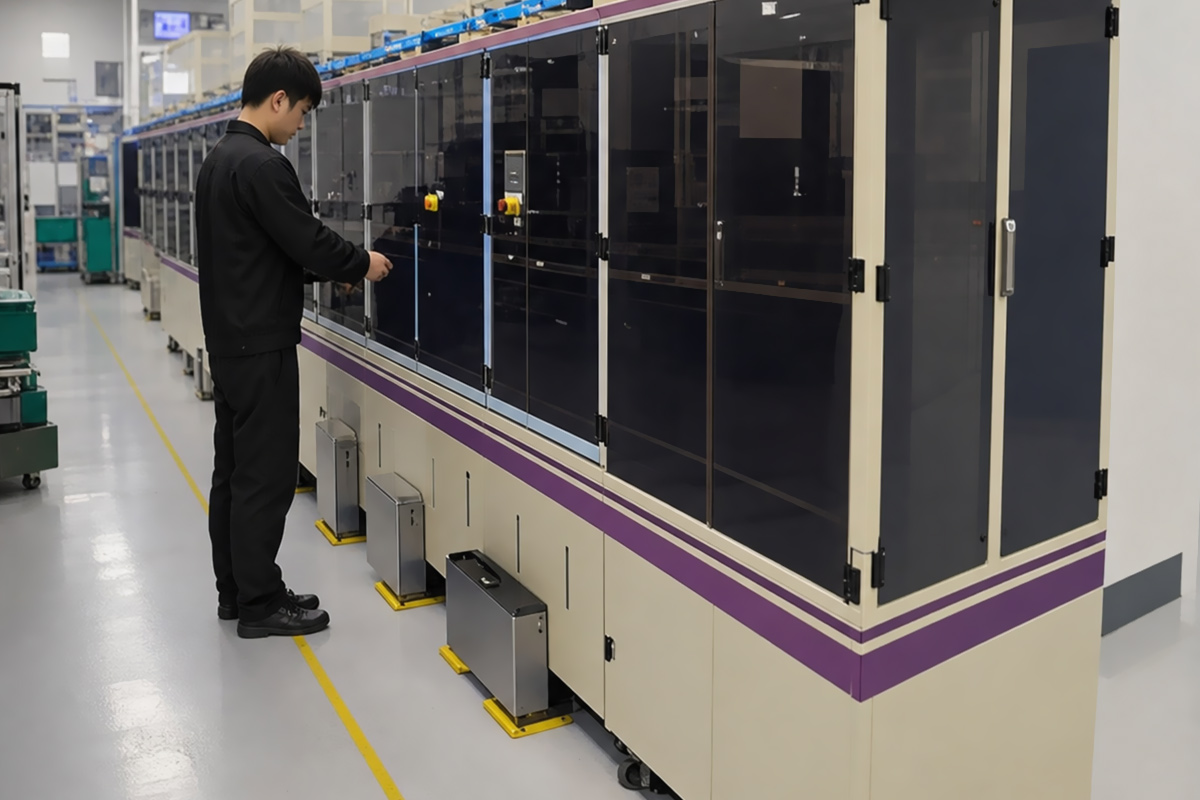
A certain company's Type-C B747 USB-C five-in-one automatic assembly, inspection and packaging line
Type-C connectors perform key functions such as charging, data transmission, and electromagnetic shielding in consumer electronics products. The structure is miniaturized, process complexity, and testing requirements continue to increase. The B747 USB-C five-in-one automatic assembly, inspection and packaging line is oriented to the equipment needs of Apple headphone charging boxes and the manufacturing needs of Luxshare precision connectors. MIJOINT Intelligence provides the project with a full-process automation solution covering assembly, welding, inspection, testing and packaging.
Project background
PPT data shows that the project requires the completion of five-in-one Center Plate, Upper IM, Lower IM, upper and lower EMI assembly and welding, OM inspection and packaging, HSG assembly, main line Shell Assembly welding, electrical testing, air tightness testing, AOI inspection, 3D line scanning and packaging. Compared with a single work station, this project is more like the continuous integration of a set of high-precision processes.
The Type-C connector is used in the AirPods charging box, integrating charging, data transmission and electromagnetic shielding functions to ensure stable device interaction and efficient charging with miniaturization and high reliability. Therefore, the project not only requires assembly accuracy, but also requires welding quality, electrical function, air tightness, appearance and dimensional inspection to all be included in the closed loop.
Automation solution
MIJOINT intelligently built a multi-section automation line around the B747 USB-C product. The layout includes five-in-one assembly, OM automatic inspection and packaging, HSG assembly machine and main-line Shell assembly inspection and packaging machine. Each section of equipment is connected front and back, and master-slave synchronization and buffering station matching are used to ensure smooth connection between processes.
In the assembly process, the project adopts a full cam cutting assembly structure, taking into account both accuracy and speed. The assembly and positioning accuracy of the PPT marked five-in-one Center Plate and upper and lower EMI components reaches ±0.01mm, and the device CT can reach 0.8s. Visually guided welding and energy monitoring are used in the welding process to reduce the impact of welding position deviations and energy fluctuations on product quality.
The testing link is an important part of the project. The project integrates AOI appearance inspection, 3D line scan dimensional measurement, electrical testing and air tightness testing to build a multi-dimensional inspection and real-time error correction system, and can link with the MES system for data management and process optimization.
Process Difficulties
The first type of difficulty is the stable feeding of the continuous material belt. Continuous belts require servo tension, deviation correction and precise positioning to achieve stable feeding.If the feeding is unstable, subsequent cutting, assembly and welding will be affected.
The second type of difficulty is matching the front and back online beats. Five-in-one assembly, OM inspection and packaging, HSG assembly and Shell main line process lengths are different, and the complexity of actions is different. It is necessary to coordinate the rhythm through master-slave synchronization and buffer stations to avoid a certain section becoming a bottleneck.
The third type of difficulty is the cam mechanism and flatness control. The project requires high-precision machining, backlash elimination and calibration to improve repeatability, while ensuring product flatness through low-stress design, precision fixtures and online inspection.
The fourth type of difficulty is quality closed loop. Type-C connectors also involve structural, welding, electrical and airtight quality, and a single test cannot cover all risks. MIJOINT establishes a more complete process control system through AOI, 3D line scanning, electrical testing, air tightness testing and MES data linkage.
Customer value
The B747 USB-C project helps customers integrate multiple complex processes from manual or distributed equipment modes into full-process automation lines. Through multi-dimensional inspection and real-time error correction system, the project reduced the defect rate to less than 0.03%. This shows that the automated entire line not only improves efficiency, but also supports the stable quality of consumer electronics precision connectors.
For consumer electronics customers, product life cycles are short, and the speed of new product introduction and production capacity ramp-up is very critical. MIJOINT Intelligence demonstrated high-precision cam assembly, vision-guided welding, automatic disk changing, DD motor transmission and multi-dimensional detection closed-loop capabilities in this project, providing a reusable solution for subsequent Type-C series products and precision connector projects.