

Automotive Electronics Cases
Fakra wire harness product automatic line of a certain company
New energy vehicles and automotive electronics are developing rapidly. Vehicle cameras, high-speed transmission modules, radars and domain control systems have put forward higher requirements for radio frequency harnesses and connectors. As an important component of automotive RF signal connection, Fakra wire harness needs to take into account stripping accuracy, crimping quality, assembly stability and full-process inspection. Focusing on BYD and TOYOTA automotive camera and high-speed transmission module needs, as well as ETC automotive wiring harness needs, MIJOINT intelligently provides Fakra wiring harness product automatic lines.
Project Background
Fakra wiring harness is a radio frequency connection harness specially designed for the automotive industry. With Fakra connector as the core component, it is mainly used for radio frequency signal connection and transmission between various electronic devices in the car. As smart car functions increase, Fakra wiring harnesses must not only meet connectivity needs, but also ensure signal stability and long-term reliability.
The project completed processes such as core wire processing, riveting wire clips, riveting center pins, main body assembly, and riveting the main body, and quality control was carried out through AOI detection of core wire processing dimensions, GT depth detection dimensions, pressure detection and appearance inspection. This type of project requires very high requirements for the continuous stability of wire stripping, crimping, assembly and testing.
Automation solution
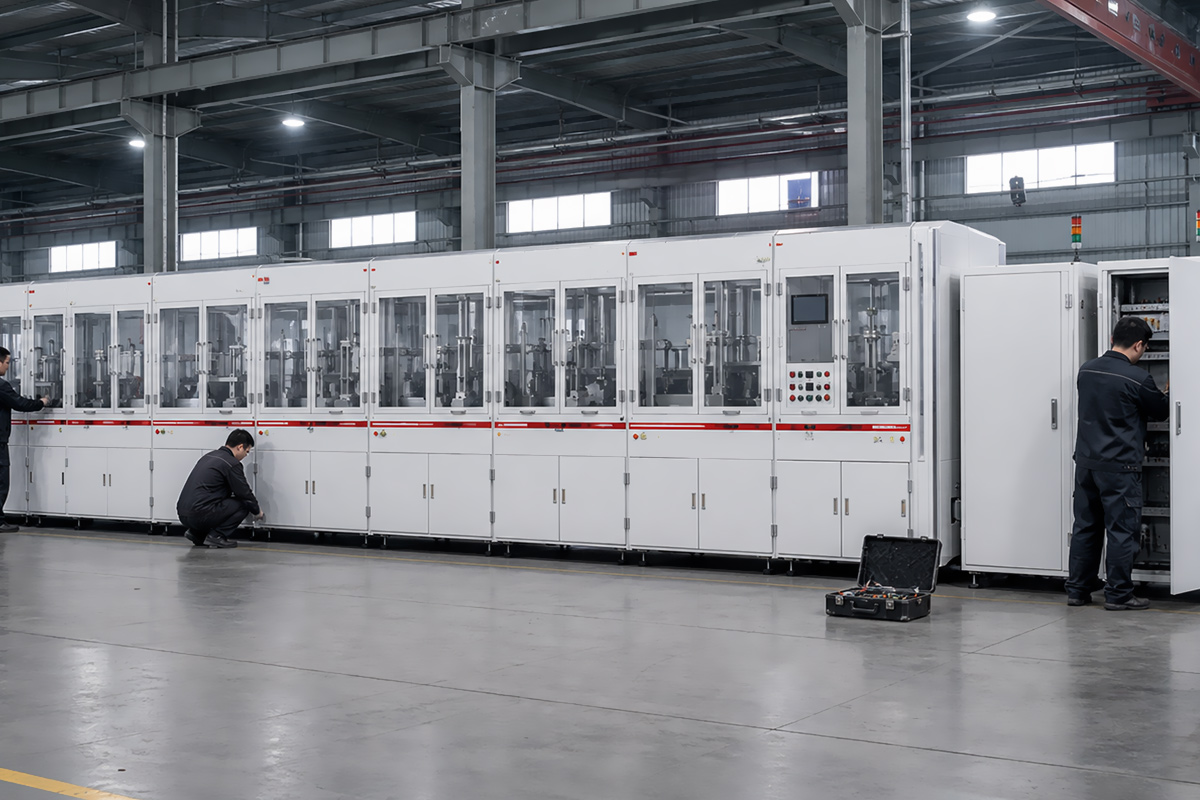
MIJOINT intelligently designed an automated complete line for the Fakra wire harness project. The layout includes long wire winding and wiring machines, short wire double-head/single-head double-wire wiring machines, wire pre-processing machines, assembly terminal machines, assembly main machines, and GT Detection depth and electrical measuring machine, defective cutting machine and other modules.
The entire line revolves around wire loading, wire stripping, wire clamp riveting, center pin riveting, main body assembly, main body riveting and inspection. The equipment reduces dimensional fluctuations and the risk of missed inspections in manual processing through automatic wire stripping, servo parameter adjustment, pressure detection, visual inspection and electrical measurement.
In terms of key stand-alone capabilities, the rotary coaxial three-knife servo wire stripping machine. This equipment is compatible with one-click type change of a variety of wires, and supports end stripping, mid-section stripping and multi-section stripping. The equipment is CT 5s and the equipment accuracy is ±0.01mm. The three-knife collaborative design is particularly suitable for solving the core problem of step stripping of coaxial cables.
Process Difficulties
The first type of difficulty in the Fakra project is coaxial cable stripping. It is not allowed to cut the braid during the stripping process. The cuts of the sheath, braid, aluminum foil and insulation stripping must be smooth. Any stripping deviation may affect subsequent crimping, assembly and signal stability.
The second type of difficulty is crimping and main body assembly. Components such as wire clamps, center pins, and main bodies need to be assembled continuously in multiple stations, and the crimping depth, pressure curve, and position consistency must be stable. Project passed pressure inspection, GT depth inspection and AOIDetection reduces unwanted outflow.
The third type of difficulty is multi-mode production. Long wire winding and on-line, short-wire double-ended/single-ended, double-wire on-line and other modes appear in the layout at the same time, indicating that customers have many wire harness specifications and production methods. The automation solution needs to take into account multi-specification switching and on-site production efficiency.
Customer Value
Fakra’s wire harness product automatic line integrates wire processing, crimping, assembly and inspection into a continuous automated process, reducing the impact of manual wire stripping and manual assembly on quality consistency. For automotive electronics customers, automated lines not only improve efficiency, but more importantly, improve process controllability and traceability.
Automotive parts have strict quality requirements. Once the wiring harness products enter the vehicle system, the cost of locating quality problems in the later period is high. Through AOI, GT depth inspection, pressure inspection, electrical measurement and appearance inspection, MIJOINT intelligently helps customers establish a multi-dimensional inspection mechanism at the production site to provide support for large-scale, high-reliability delivery.