
Product Knowledge
99% of People Don’t Realize How Complex Automotive Wire Harnesses Really Are
1. An Automotive Wire Harness Is More Than “A Few Wires Tied Together”
A complete automotive wire harness typically contains dozens—or even hundreds—of components, including wires, terminals, connectors, protective sleeves, tapes, corrugated tubing, and clips.
2. The Wiring in a Single Vehicle Can Extend for Several Kilometers
The total length of wiring in a conventional internal-combustion vehicle can reach several kilometers. Because new energy vehicles contain more electrical and electronic systems, their wiring harness systems can be even more complex.
3. Abrasion Can Be a Greater Threat Than High Current
A wire harness may continuously rub against sheet-metal body panels and brackets. Over time, this can damage the insulation and eventually cause short circuits or electrical failures.
4. Harness Tape Is Not Just for Appearance
In addition to securing the harness, tape helps prevent abrasion, suppress noise, resist water and dust, and maintain the intended routing of the wiring.
5. Wires of the Same Diameter Can Serve Completely Different Purposes
Wire size is selected according to operating current, temperature rise, cable length, voltage drop, ambient temperature, and other factors. A thicker wire is not necessarily better.
6. Why Do Automotive Wire Harnesses Need Some Extra Length?
Components such as engines, doors, and seats move during operation. If the harness is pulled too tightly, repeated bending can cause fatigue in the internal copper conductors and eventually lead to breakage.
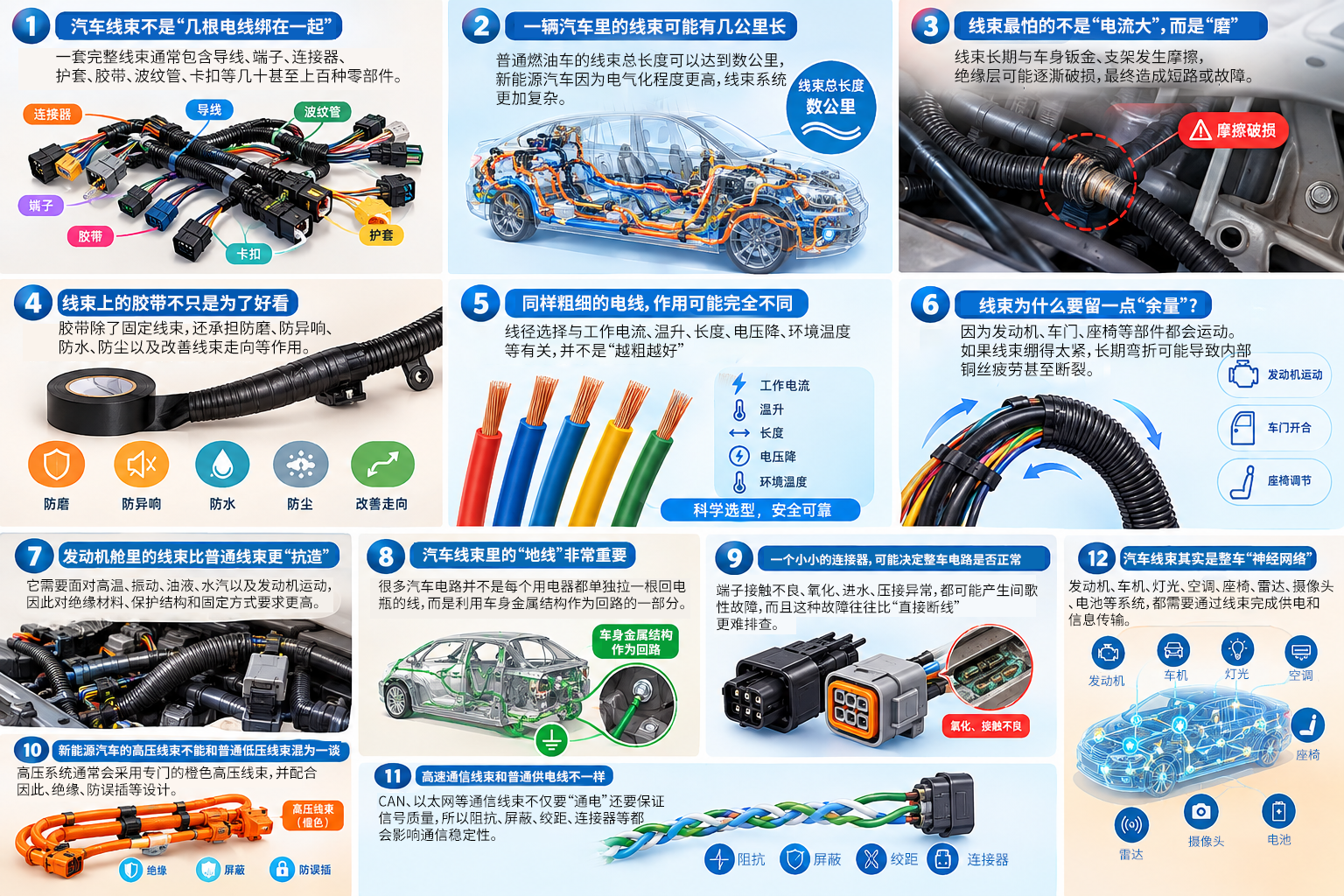
7. Engine-Compartment Wire Harnesses Must Withstand Harsher Conditions
They are exposed to high temperatures, vibration, oil, moisture, and engine movement. This places greater demands on insulation materials, protective structures, and fastening methods.
8. Grounding Wires Play a Critical Role in Automotive Electrical Systems
Many automotive circuits do not use a separate return wire from every electrical component to the battery. Instead, the vehicle’s metal body serves as part of the electrical return path.
9. A Small Connector Can Determine Whether the Vehicle’s Electrical System Operates Properly
Poor terminal contact, oxidation, water ingress, and improper crimping can all cause intermittent failures. These faults are often more difficult to diagnose than a completely broken wire.
10. High-Voltage Harnesses in New Energy Vehicles Are Not the Same as Conventional Low-Voltage Harnesses
High-voltage systems typically use dedicated orange cables together with shielding, insulation, and mis-mating prevention features.
11. High-Speed Communication Harnesses Differ from Ordinary Power Cables
Communication harnesses used for CAN, automotive Ethernet, and similar systems must do more than conduct electricity—they must also maintain signal integrity. Impedance, shielding, twist pitch, and connector performance can all affect communication stability.
12. The Automotive Wire Harness Is the Vehicle’s “Nervous System”
The engine, infotainment system, lighting, air conditioning, seats, radar, cameras, battery, and other systems all rely on wire harnesses for power delivery and data transmission.
MIJOINT Intelligent Technology (Guangdong) Co., Ltd. (“MIJOINT”) was founded in 2018 and is headquartered in Songshan Lake, Dongguan—one of China’s leading innovation hubs. MIJOINT specializes in customized automation equipment for AI high-speed cables, connectors, optical fibers, optical transceivers, and related applications, providing integrated solutions covering sales, R&D, manufacturing, and after-sales service.