
Product Knowledge
What You Should Know About High-Speed Cable Lifespan
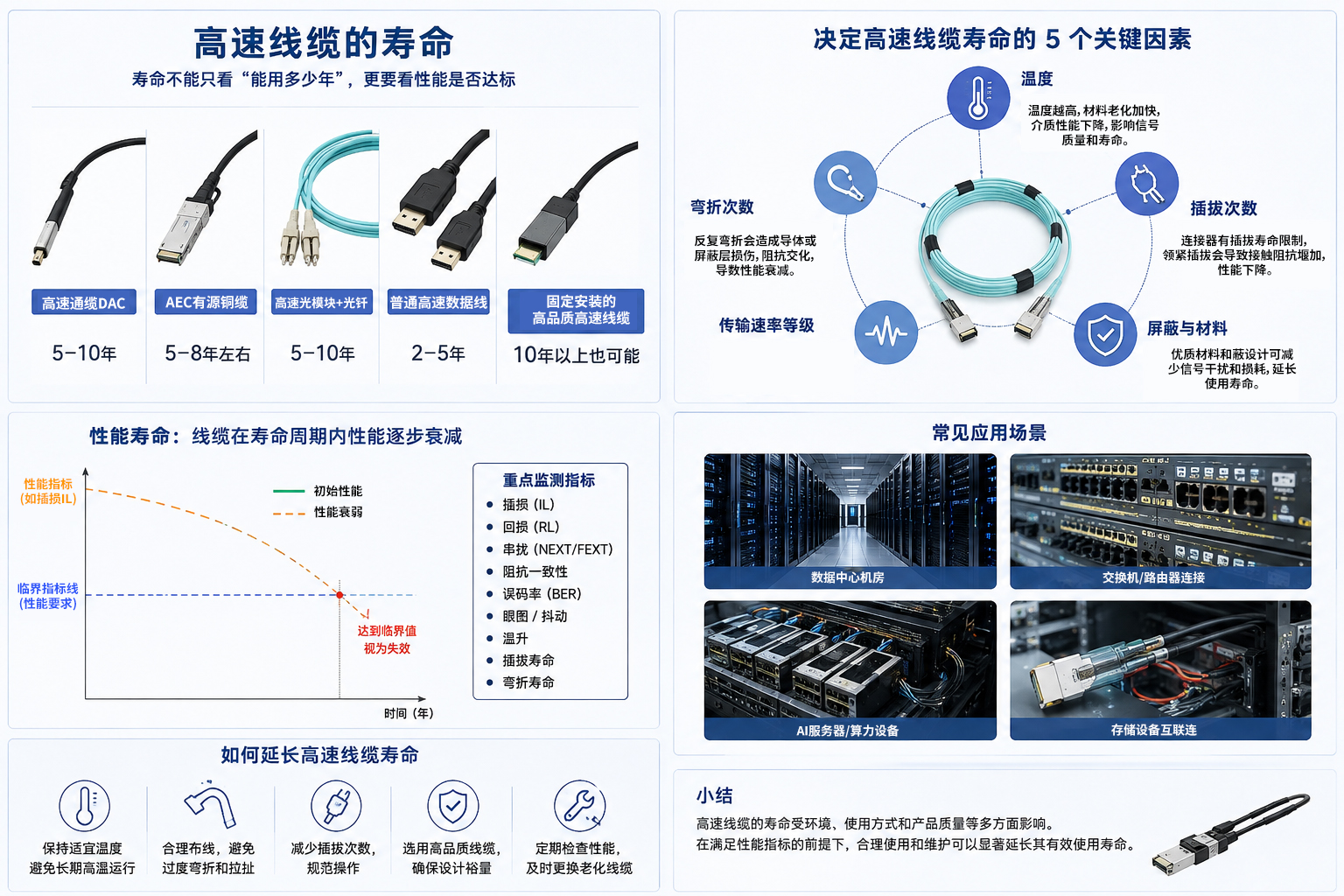
The lifespan of a high-speed cable cannot be measured only by the number of years it remains usable. Transmission rate, cable structure, operating environment, and the number of mating and bending cycles must also be considered.
For high-speed copper cables and other high-speed interconnect cables used in data centers, servers, and AI computing equipment, service life can be evaluated based on the following factors.
Five Key Factors That Determine High-Speed Cable Lifespan
1. Temperature Is One of the Most Important Factors
For high-speed cables supporting 56G, 112G, and 224G PAM4 transmission, higher temperatures not only shorten service life but can also directly affect signal quality.
For example:
Higher temperature → Faster material aging → Degraded dielectric properties → Changes in impedance and loss → Higher BER → Reduced data rates, packet loss, or link failure
High-speed cables installed inside server rooms, switches, and AI server racks may therefore have a significantly shorter service life when continuously exposed to high temperatures.
2. Number of Bending Cycles
High-speed cables are sensitive to changes in their mechanical structure, particularly:
- 112G and 224G PAM4 cables
- Ultra-fine high-speed copper cables
- Active copper cables
- High-speed optical fiber cables
Repeated bending can cause:
Conductor or shielding damage → Impedance variation → Degraded return loss → Increased insertion loss → Higher bit error rate
In many cases, a high-speed cable does not fail simply because its materials have aged. Its transmission performance may deteriorate first because of mechanical fatigue.
3. Number of Mating Cycles
Connectors are another potential service-life bottleneck in high-speed cable assemblies.
Product specifications generally define a rated mating life, such as:
500, 750, 1,000, 1,500 cycles, or more
However, an important distinction must be made:
A connector that can still be mechanically inserted does not necessarily continue to meet its high-speed electrical performance requirements.
Changes in contact resistance, terminal wear, contamination, and other connector-related issues can all degrade high-speed signal quality.
4. Higher Data Rates Increase Sensitivity to Service Life and Manufacturing Quality
This is an important consideration when evaluating the development challenges and quality of high-speed cables.
As transmission rates increase:
10G → 25G → 56G → 112G → 224G
The system imposes increasingly stringent requirements on:
- Insertion loss (IL)
- Return loss (RL)
- Near-end and far-end crosstalk (NEXT/FEXT)
- Impedance consistency
- Delay skew
- Bit error rate (BER)
- PAM4 signal integrity
A high-speed cable may therefore remain physically intact while no longer delivering acceptable transmission performance.
The lifespan of a high-speed cable is better defined as:
The effective operating period during which the cable continues to meet specified transmission performance requirements under defined environmental and operating conditions.
It should not be evaluated solely by checking whether the outer jacket is damaged.
For high-speed cable products, greater attention should be paid to performance life. A typical service-life evaluation can follow this sequence:
Initial Performance → Aging Test → Performance Degradation → Critical Threshold → Failure
Key parameters to monitor include:
- Insertion loss
- Return loss
- Crosstalk
- Impedance
- Bit error rate
- Eye diagram
- Jitter
- Temperature rise
- Mating-cycle life
- Flex-cycle life
For 112G and 224G high-speed cables in particular, conventional continuity testing alone is not sufficient to determine service life.